
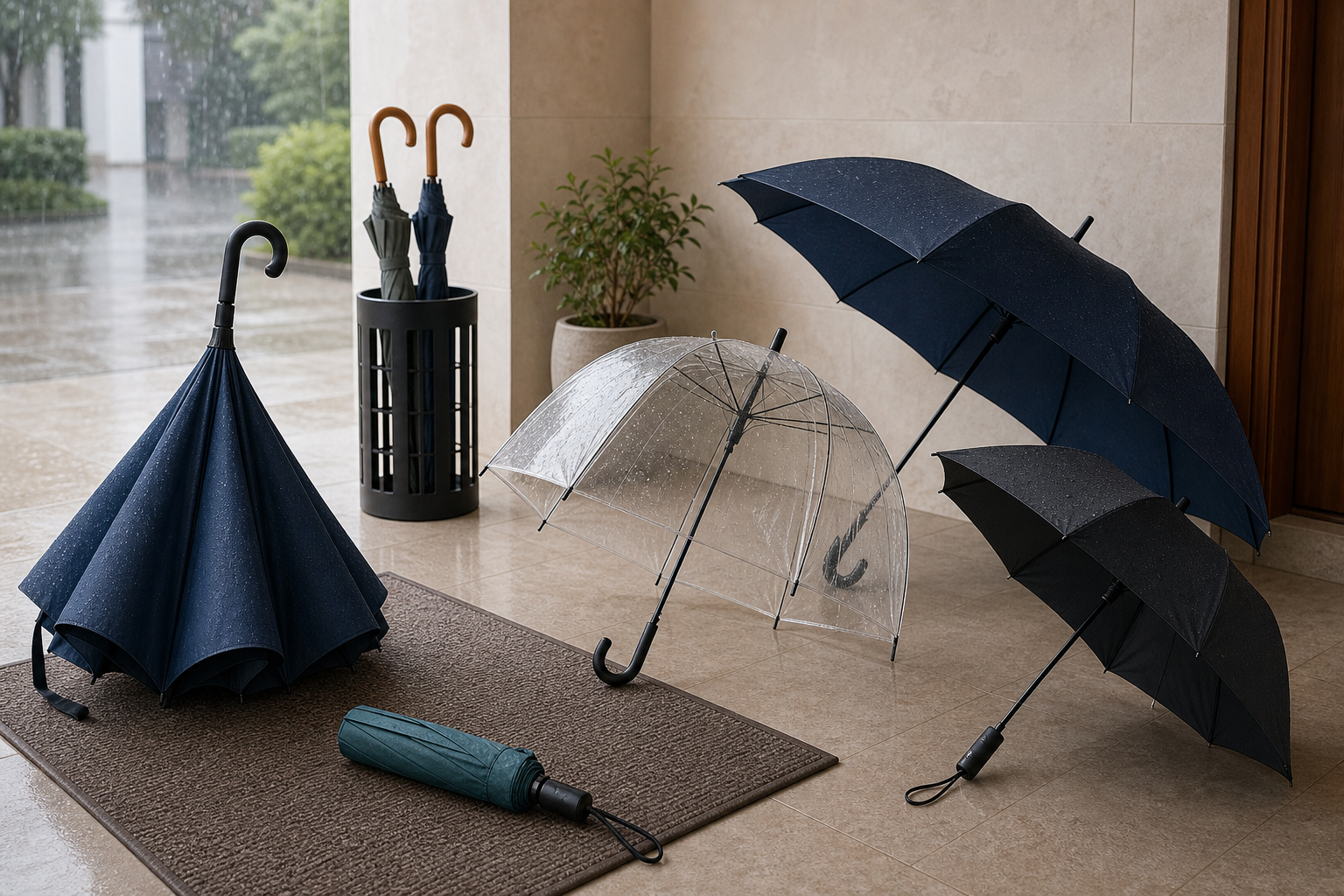
The short answer: choose an umbrella by the trip you make most often. A reversible design can keep the wet surface folded inward at a doorway; an automatic model prioritizes one-hand operation; a transparent canopy improves the view ahead; a two-person or couple umbrella emphasizes shared coverage; and a compact folding umbrella is easiest to carry. None is automatically safest or strongest—compare the current listing's dimensions, mechanism, materials and instructions for the exact variant.
This guide is for everyday rain planning in the United States and Canada. Product names may contain terms such as “windproof,” “waterproof,” “UV protection” or “world's first.” Treat those as listing language, not independent guarantees. A severe-weather warning always outranks a product claim.
Umbrella types at a glance
| Type | Useful when | Check before ordering | Main trade-off |
|---|---|---|---|
| Reversible / inverted | Moving through car doors and building entrances | Closed length, open diameter, handle, manual or automatic action | Often bulkier than a mini folding model |
| Automatic folding | One hand may be occupied | Whether the button opens only or opens and closes; reset instructions | More moving parts and spring tension |
| Transparent dome | Forward visibility matters on busy sidewalks | Canopy depth, diameter, trim and closed length | Clear material can show water spots and creases |
| Couple / two-person | Two people want shared rain coverage | Canopy width, two-pole layout, weight and packed size | Needs more clearance on sidewalks and at doors |
| Compact folding | Commuting and travel with limited bag space | Folded length, weight, sleeve, handle and opening action | Smaller models may provide less shoulder or bag coverage |
1. Reversible umbrellas: plan for the doorway
A reverse-folding canopy closes in the opposite direction from a conventional umbrella. That can help contain some surface water while you step into a car or entryway, but it does not make the umbrella leak-proof, drip-free or storm-safe. Compare the Smart-Brella reversible umbrella with the automatic folding inverted umbrella with LED flashlight. Confirm the selected variant's open diameter, closed length, operating sequence and any light or battery instructions.
Practice opening and closing a new mechanism in a dry, open area. Keep fingers away from sliders, hinges and spring-loaded joints. At a doorway, point runoff toward the mat or exterior rather than other people, merchandise or an electrical outlet.
2. Automatic umbrellas: read what the button actually does
“Automatic” is not one universal mechanism. Some buttons open the canopy; some listings describe automatic open and close; and a collapsed shaft may still require manual resetting. Never force a telescoping shaft or press the release near another person's face. The double automatic folding umbrella is one catalog option, but its product-title use of “windproof” should not be interpreted as permission to use it in dangerous gusts.
For commuters, map the folded dimensions against the actual bag pocket and allow room for a sleeve. A heavier handle may feel stable in the hand but adds daily carry weight. Check the variant description instead of assuming every colour has identical specifications.
3. Transparent umbrellas: visibility with a maintenance trade-off
A clear canopy can make it easier to see signs, people and the path ahead without tilting the umbrella as far back. The automatic transparent umbrella is worth comparing when visibility is the priority. Inspect the current photos for canopy depth and trim, then verify diameter and length in the listing.
Clear films can show droplets, mineral marks and folding creases more readily than dark woven canopies. Shake off loose water only where there is ample clearance, open it to dry in a ventilated location, and use only the maker-approved cleaning method. Avoid abrasive pads, hot air and harsh solvent cleaners.
4. Couple umbrellas: coverage needs clearance
The automatic two-person couple umbrella is designed around shared coverage. Before choosing it, consider both canopy span and walking environment. A wide canopy may be practical on an open route but awkward on crowded sidewalks, transit platforms, shop aisles or narrow doorways.
Agree who will steer the umbrella, slow down near others, and lift or angle it only when that can be done without exposing ribs or tips at eye level. Shared coverage also changes balance: do not treat a larger canopy as inherently more wind resistant.
5. Measure coverage and packed size
- Measure the bag, car-door pocket or entry stand where the closed umbrella will live.
- Compare closed length and weight, not just canopy diameter.
- For shoulder bags or backpacks, allow coverage for the person and carried item.
- Check handle style and wrist strap without assuming either is a safety restraint.
- Review the exact variant, shipping estimate and return terms before checkout.
Canopy diameter is usually measured across the open umbrella, but listing conventions can vary. Do not derive size from a lifestyle photo. If dimensions are essential, confirm them with the store before ordering.
Wet handling, drying and storage
Before entering, pause under cover and let water drain. Do not shake a canopy near faces, glassware, electronics or a slippery walkway. Close it according to its mechanism, place it on an absorbent mat or in a stand, and wipe pooled water from the floor promptly.
For drying, follow the product instructions. In general, allow the canopy to dry fully in moving room-temperature air before fastening the wrap or putting it into a sleeve. Keep it away from heaters and open flames. When dry, brush away loose debris gently and inspect ribs, tips, fabric, fastener, shaft and handle. Retire or repair an umbrella if sharp parts are exposed, the lock does not hold, or the mechanism behaves unpredictably.
Wind and lightning safety comes first
The U.S. National Weather Service says to seek a sturdy building during a high-wind warning or severe-thunderstorm warning. In strong gusts, close the umbrella if that can be done safely and move indoors; do not fight an inverted canopy beside traffic. No consumer umbrella makes severe winds safe.
An umbrella is not lightning protection. The National Weather Service states there is no safe place outside when thunderstorms are nearby: if you hear thunder, go indoors or into a hard-topped vehicle. Do not shelter under an isolated tree, open pavilion or the umbrella itself.
Frequently asked questions
Does a reversible umbrella eliminate dripping?
No. Folding the wet surface inward may contain some water temporarily, but runoff remains. Drain it responsibly and let it dry completely.
Does automatic mean both open and close?
Not always. Read the exact control description and reset instructions for the selected product.
Is a transparent umbrella better for walking?
It may improve the view through the canopy, but fit, clearance, footing, traffic awareness and weather conditions still matter.
Is a “windproof” umbrella safe in high winds?
No blanket conclusion follows from that word in a product title. Follow official alerts and seek sturdy shelter during dangerous wind.
Can an umbrella protect me from lightning?
No. If thunder is audible, move to a substantial building or hard-topped vehicle rather than remaining outdoors.
Bottom line
Choose reversible for doorway handling, automatic for operating convenience, transparent for visibility, couple for shared coverage, or compact folding for portability. Verify the exact specifications, operate it away from others, dry it before storage, and treat official storm guidance—not marketing language—as the safety standard.